Hi,
Are you against nuclear energy?
We need electricity. Clean energy is what we want. Energy from burning coal produces carbon dioxide. Energy from nuclear sources produces nuclear wastes which emit lethal radiations for tens of hundreds of years. It has to stored safely, usually buried underground.
Listen to this debate and make up your own mind.
Cheers
Saturday, July 31, 2010


Plastic bags pollute the environment
Hi,
Australia, South Africa, India, China, Italy, Bangladesh and Taiwan have banned, or instituted partial bans on plastic bags to combat the serious environmental threats they pose. Ireland imposes a tax on each bag, which is another way to slow down their use (after the tax, consumers’ usage dropped 90%). In March 2007, the City of San Francisco was the first major United States city to ban plastic bags, and Oakland soon followed suit
Read the full article at http://www.peachygreen.com/going-green/oregon-considers-plastic-bag-ban
Cheers
Australia, South Africa, India, China, Italy, Bangladesh and Taiwan have banned, or instituted partial bans on plastic bags to combat the serious environmental threats they pose. Ireland imposes a tax on each bag, which is another way to slow down their use (after the tax, consumers’ usage dropped 90%). In March 2007, the City of San Francisco was the first major United States city to ban plastic bags, and Oakland soon followed suit
Read the full article at http://www.peachygreen.com/going-green/oregon-considers-plastic-bag-ban
Cheers
Tuesday, July 13, 2010
Molecular Genetics, cell divisions, ecology, selection
Hi Students,
Below are a few links I found very useful in understanding concepts in Molecular Biology and genetics. Difficult concepts in cell division are also dealt with.
Ecology, bioaccumulation and bio-magnification are also dealt with in the powerpoints slideshows listed below.
Ecology, bioaccumulation and bio-magnification are also dealt with in the powerpoints slideshows listed below.
I will go through these slideshows in class. You may want to browse through them for better understanding.
Cheers
Thursday, July 8, 2010
I do not know if this can be recycled
Hi,
We are sometimes not sure which items to place in our recycling bags or bins.
Zerowastesg has compiled a list of 70 common waste items and checked with the National Environment Agency (NEA) on whether these items are acceptable for recycling through the NRP or recycling bins.
Click at this link http://www.zerowastesg.com/our-initiatives/can-recycle/and find out for yourself.
The recyclables and those that cannot be recycled through the NRP or recycling bins are given. Point and click your cursor on the image and you can see the description of the item with comments from the NEA.
Please do not forget to share this information with all your friends and family.
Cheers
We are sometimes not sure which items to place in our recycling bags or bins.
Zerowastesg has compiled a list of 70 common waste items and checked with the National Environment Agency (NEA) on whether these items are acceptable for recycling through the NRP or recycling bins.
Click at this link http://www.zerowastesg.com/our-initiatives/can-recycle/and find out for yourself.
The recyclables and those that cannot be recycled through the NRP or recycling bins are given. Point and click your cursor on the image and you can see the description of the item with comments from the NEA.
Please do not forget to share this information with all your friends and family.
Cheers
Tuesday, June 15, 2010
Mental health and nature deficit disorder are related?


I read "Can playing in the dirt make you smarter?" and was even more convinced that a daily dose of nature is important in our mental and physical well-being. It is even more important in Singapore as we live in high-rise apartments and do not come into contact with soil and gardening is not in our list of things to do everyday or even on weekends.
Linda Buzzell, a psychotherapist, wrote about this in http://www.huffingtonpost.com/linda-buzzell/garden-guide-can-playing_b_591254.html
"The science supporting the mental health benefits of gardening and outdoor activities in general just gets stronger with each new study. We need to help our kids -- and ourselves -- recover from what author Richard Louv (Last Child in the Woods) calls "nature deficit disorder."
These studies encourage all of us to support our local communities by building a school garden at every educational institution in our area, increasing the availability of community gardens for everyone who wants a plot of soil to dig their fingers into and -- perhaps most important -- shrinking our lawns and growing some of our own food."
The original article is found at www.sciencedaily.com/releases/2010/05/100524143416.htm
I also wrote about this in this blog earlier, in May. It is found at http://asal-sakti.blogspot.com/2010/05/fun-filled-carefree-and-myopia-free.html
Cheers
Tuesday, June 8, 2010
Giant solar Flares predicted in May 2013
Hi,


In 1859, a geomagnetic storm sparked by a huge solar flare swept over the Earth. Telegraph wires shorted out and set houses on fire. A brilliant aurora was seen in Hawaii—so bright that "people could read newspapers by [its] red and green glow."
Scientists predict that in May 2013, the sun's solar cycle will peak at about the same level as in 1859.
Next week, scientists will meet at the Space Weather Enterprise Forum to talk about how to monitor and predict so-called "space weather"—solar flares, interplanetary magnetic fields, etc.
They predict a marked increase in solar storms over the next few years. According to NASA scientist Richard Fisher: "The sun is waking up from a deep slumber, and in the next few years we expect to see much higher levels of solar activity."
This is bad news for anyone who likes electronic things.
We're so dependent on technology hooked up to satellites, which can be disabled or destroyed by huge waves of charged particles spit out by the sun during a solar storm: GPS, cell phones—even credit card transactions use a satellite. A severe solar storm will knock out commercial satellites, blow down transformers, power lines, "leaving millions of people in northern latitudes without power."
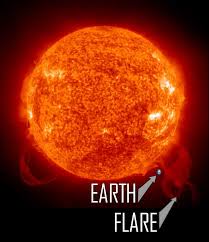
In 1859, a geomagnetic storm sparked by a huge solar flare swept over the Earth. Telegraph wires shorted out and set houses on fire. A brilliant aurora was seen in Hawaii—so bright that "people could read newspapers by [its] red and green glow."
Scientists predict that in May 2013, the sun's solar cycle will peak at about the same level as in 1859.
Next week, scientists will meet at the Space Weather Enterprise Forum to talk about how to monitor and predict so-called "space weather"—solar flares, interplanetary magnetic fields, etc.
They predict a marked increase in solar storms over the next few years. According to NASA scientist Richard Fisher: "The sun is waking up from a deep slumber, and in the next few years we expect to see much higher levels of solar activity."
This is bad news for anyone who likes electronic things.
We're so dependent on technology hooked up to satellites, which can be disabled or destroyed by huge waves of charged particles spit out by the sun during a solar storm: GPS, cell phones—even credit card transactions use a satellite. A severe solar storm will knock out commercial satellites, blow down transformers, power lines, "leaving millions of people in northern latitudes without power."
Saturday, June 5, 2010
Is your crazy behaviour due to toxoplasmosis?
Hi,
I was very shocked by an article I read in The Economist June 5th 2010.
Toxoplasma gondii is a common parasite carried by cats and rats and mice. It is like Plasmodium that causes malaria in human beings. However Toxoplasma affects cats and rodents in its normal life cycle. However, if it gets into humans, it forms cysts in the brain, liver and muscles.
Its effects on the rodents is a bizarre and fatal attraction to cats! Infected rats have been shown to be attracted to the smell of cats. These rodents wander around the cat to draw attention towards them so that they will be eaten!!
In this way the parasite makes the rodent complete its life cycle.
Of course humans are not preys of cats. However when the parasites infects the brains of humans, it produces a number of strange and crazy problems.
(1)Schizophrenia is a form of severe mental problem or madness. Scientists in Johns Hopkins University proved that people who suffer from schizophrenia are 3 times more likely to be infected with toxoplasma.
(2)Scientists at Charles University in Prague proved that people involved in road accidents are 3 times more likely to be infected with toxoplasma. This is due to reduced reaction times and short attention spans of the drivers.
(3)Dopamine is a chemical molecule produced by nerve cells. It has psychotic effects. Infection with toxoplasma produces a reduction in "novelty-seeking" effect. When blood tests were conducted in different countries, the British had a infection score of only 6.6% and we all know that the Brits are calm and not easily excited (-0.8). On the other hand the French has a infection score of 45% and they are known to be outgoing and excitable.
As every science student is taught from the beginning, correlation is not causation. It could be that the symptoms are found to be more common amongst the susceptible or due to some third as yet unidentified variable.
Read more about this very ubiquitous creature at
http://en.wikipedia.org/wiki/Toxoplasma_gondii
Cheers
I was very shocked by an article I read in The Economist June 5th 2010.
Toxoplasma gondii is a common parasite carried by cats and rats and mice. It is like Plasmodium that causes malaria in human beings. However Toxoplasma affects cats and rodents in its normal life cycle. However, if it gets into humans, it forms cysts in the brain, liver and muscles.
Its effects on the rodents is a bizarre and fatal attraction to cats! Infected rats have been shown to be attracted to the smell of cats. These rodents wander around the cat to draw attention towards them so that they will be eaten!!
In this way the parasite makes the rodent complete its life cycle.
Of course humans are not preys of cats. However when the parasites infects the brains of humans, it produces a number of strange and crazy problems.
(1)Schizophrenia is a form of severe mental problem or madness. Scientists in Johns Hopkins University proved that people who suffer from schizophrenia are 3 times more likely to be infected with toxoplasma.
(2)Scientists at Charles University in Prague proved that people involved in road accidents are 3 times more likely to be infected with toxoplasma. This is due to reduced reaction times and short attention spans of the drivers.
(3)Dopamine is a chemical molecule produced by nerve cells. It has psychotic effects. Infection with toxoplasma produces a reduction in "novelty-seeking" effect. When blood tests were conducted in different countries, the British had a infection score of only 6.6% and we all know that the Brits are calm and not easily excited (-0.8). On the other hand the French has a infection score of 45% and they are known to be outgoing and excitable.
As every science student is taught from the beginning, correlation is not causation. It could be that the symptoms are found to be more common amongst the susceptible or due to some third as yet unidentified variable.
Read more about this very ubiquitous creature at
http://en.wikipedia.org/wiki/Toxoplasma_gondii
Cheers
Subscribe to:
Posts (Atom)


 Posts
Posts

