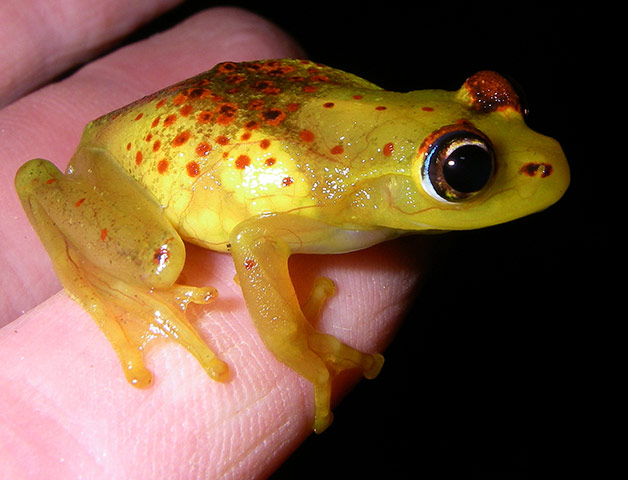
World Wildlife Fund (WWF) drew attention to Madagascar's natural wealth in biodiversity yesterday, 6/6/11. More than 600 new species discovered between 1999 and 2010.
The full article and pictures with the descriptions of their fantastic beauty can be found in the link: madagascar biodiversity:600 species discovered
" We as a species, the human race, we don't understand the complexities of the natural world around us,
yet we people are the one species with the most power to destroy or protect what's there" said Mr Richard Hughes, WWF's Madagascar's regional director.
These beautiful animals and plants which are unique to Madagascar which are already endangered because of deforestation and destruction of their habitats.
Biodiversity is has to be treasured as once it is lost, it will take ages for it to re-establish itself. I would like to share some biodiversity in my garden with you here.
Ramphotyphlops braminus is a harmless blind snake species found mostly in Africa and Asia
Slime mould (Stemonitis spp.)
Would you believe that the above photos are of a slime-mould? When the environment becomes unfavourable, the unicellular organism will gather together to form structures such as above. It was once thought to be a type of fungus because of this deceptive appearance. They are mobile and in the second photo above, it has climbed on the stems of a thaumatococcus plant to produce the spore bodies.
The Jewel Wasp, Ampulex compressa, aka Emerald Cockroach Wasp is a natural pest control in my garden. As you can see in the above two photos, the wasp is extremely beautiful, despite its unappetising (to us) diet. Actually, adult wasps feed only on nectar. The cockroach is their grub's grub.
This wasp is extremely "smart" in using its stings. It stings the cockroach twice, first in the thorax and then in the head. The first sting partially paralyses the front legs of the cockroach and the second makes the cockroach lose its instinct to escape. The cockroach becomes docile and can be led away by the antennae by the wasp.
The cockroach is brought to the burrow where the wasp lays a single egg on the cockroach's abdomen. The larva that hatches will feed on the roach in such a way that the roach remains alive for 4 to 5 days. Then the lava forms a pupa inside the roach. It will then emerge from the carcass of the roach as an adult.
The United Nations declared 2010 to be the International Year of Biodiversity. It is a celebration of life on earth and of the value of biodiversity for our lives. The world is invited to take action in 2010 to safeguard the variety of life on earth: biodiversity
Here are some ideas for you to celebrate ID for Biological Diversity: Spend the day with your loved ones and friends at the Hortpark, go on the Tree Top walk from Telok Blangah to Kent Ridge, take a walk in the secondary forests in the Botanic Gardens or the MacRitchie Reservoir or the Labrador Park.
You do not have to go to far away places like the Amazon or Kalimantan to see biodiversity. Even in urban Singapore there is much to be seen. We can even train ourselves to spot them in our own gardens.
Watch this video to understand the urgency in preserving and protecting the future of food.
With climate change happening so fast, the natural evolution of crop plants to cope with this rapid rise in temperature will not happen. Mass extinction of crop and food plants will happen very quickly. Scientists are really in a panic to save as many wild species and existing varieties of crop plants.
The seeds of these plants can then be resources which can be used for research and natural or artificial selection. The new varieties of plants created by man can then cope well with the higher temperatures and so our food production can keep pace with population growth.
30 or 40 years ago mass starvation used to be common in India and China due to rapid increases in population numbers in these countries. Research by scientists led to new strains of rice and wheat plants. Food shortages have since been forgotten due to Green Revolution, as it is called.
Scientists are coming to our rescue again to avert another catastrophe. This time the cause is different, extinction of food crops due to rapid global warming.
The sun is the ultimate source of energy that powers all food chains. Sunlight energy is captured by green plants and passed on to the other organisms along the food chains. Without this original (asal) energy there will be no energy to power (sakti) ecosystems.
The painting at top shows how Man and his machines could easily destroy the delicate and beautiful balance of Nature, which we can crush as easily as soap bubbles.




 Posts
Posts

