Hi,
Pollination: it's vital to life on Earth, but largely unseen by the human eye. Filmmaker Louie Schwartzberg shows us the intricate world of pollen and pollinators with gorgeous high-speed images from his film "Wings of Life," inspired by the vanishing of one of nature's primary pollinators, the honeybee.
cheers
Showing posts with label pollination. Show all posts
Showing posts with label pollination. Show all posts
Sunday, January 22, 2012


Saturday, August 15, 2009
Pollination and sexual reproduction in plants
Hi,
Pollination involves flowers and pollen grains. The agents of pollination could be insects such as bees, ants, bats and other animals that visit flowers to get their food- pollen grains and nectar.
After the pollen grain is successfully transferred from the anther to the stigma, fertilisation process will kick in. This process is different from that in animals as the pollen grain germinates and grows a pollen tube will allows the male gamete to travel through the tube to the ovule.
Flowers go to great lengths to avoid self-fertilisation and prefer cross-fertilisation. It is fascination to see this processes employed in the different species of flowering plants.
Watch these two videos to clarify these concepts.
Cheers
Pollination involves flowers and pollen grains. The agents of pollination could be insects such as bees, ants, bats and other animals that visit flowers to get their food- pollen grains and nectar.
After the pollen grain is successfully transferred from the anther to the stigma, fertilisation process will kick in. This process is different from that in animals as the pollen grain germinates and grows a pollen tube will allows the male gamete to travel through the tube to the ovule.
Flowers go to great lengths to avoid self-fertilisation and prefer cross-fertilisation. It is fascination to see this processes employed in the different species of flowering plants.
Watch these two videos to clarify these concepts.
Cheers
Sunday, March 15, 2009
Can you imagine a world without honeybees?
_bees.jpg)
Hi,
I have been reading about a phenomenon called "hive collapse" or "Colony Collapse Disorder" (CCD) for a couple of years now.
 It seems that there are fewer and fewer honeybees available for pollinating the fruit orchards in Europe and North America. Honeybees are grown in portable hives and they are rented out to farmers who grow fruit trees. The honeybees are delivered to the orchards and left there during the flowering season. the bees fly out and do their job which is to collect pollen grains and nectar from the flowers. they return back to the hives and spit out some of their saliva and mix the collected pollen grains and nectar to mix a potent concoction which we call honey.
 But the size of bee hives began to decline mysteriously. Fewer bees would return to the hive than would leave to forage until there were too few left to sustain the hive. And so they would 'collapse', i.e. the bees abandon the hive (few dead bees are found near their hive).
Why are we so alarmed when the number of bees decline?
Bees are one of the major pollinators of flowering plants. They are important commercially for their power in pollinating crops. Without pollination, many of our crops will not set fruit. Their flowers would just wither and drop off.
Which types of plants need honeybees to pollinate them?

All flowers that are colourful and scented. These flowers open in the daytime and attract they honeybees with their scent and showy petals. These flowers also have special arrangement of features which will be ensure that the anther will brush against the body of the bee as it lands and enters the base of the flower to collect the nectar from the nectaries. Some flowers won't even release their pollen until the bees buzz or vibrate their bodies against the anthers.

Some flowers bloom at night, so depend on other creatures to pollinate them, like bats. These flowers a usually white and rely on being heavily scented to attract pollinators. One common example is 'Queen of the Night' or keng huay (right).
Which farmers need not worry if all bees disappear from the earth?
 |  |
| A wheat flower | A rice flower |
 | 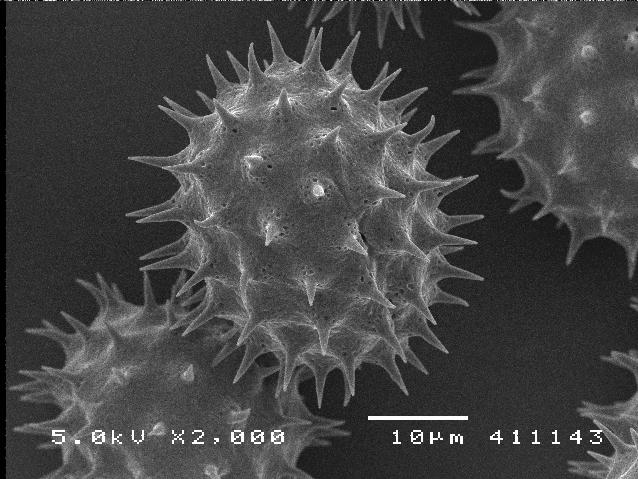 |
| Smooth, round grains of grass pollen | The highly sculpted (spiky) grains of a bee-pollenated sunflower. Note: the sunflower pollen grain is about twice the size of the grass pollen |
What is the latest news on CCD?
Nobody really knows what causes hives to collapse, and it could be several things combined. One theory is that it is caused by a parasitic mite. It could also be a virus, a fungus from Asia, pesticides, the transport of the hives, GM (Genetically Modified) crops and even radiation from mobile phones!
Recently, some new evidence has emerged due to the current world-wide economic recession. Along with many other commodities, the market for Californian almonds has collapsed, but their bee pollinators have not! There is actually a glut of hives, forcing scientists to ask if CCD really is a problem.
It is now suggested that CCD is caused by a combination of all the bee diseases with the last straw being: poor nutrition. Yes, bees that bring us delicious and nutritious honey may be malnourished. The problem is that domestic honey bees are set to forage among monocultural crops lacking in vitamins and minerals needed by the bees, while their wild cousins get a varied diet of many different flowering plants. So their immune systems become compromised and they are susceptible to disease. Hence CCD.
Since not so many bees are needed in the almond groves and apple orchards, the hives stay at home and get to forage promiscuously — and do not collapse so readily.

It is no surprise, then, that wildflower honey is considered healthier than normal honey.
This potential answer to the puzzle does not mean we have nothing to worry about. But it does offer food for thought about how we produce our food and the benefits of a varied diet - for bees and for us.
Subscribe to:
Posts (Atom)


 Posts
Posts

