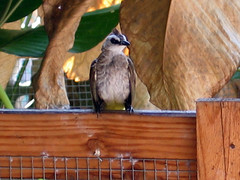
 Why they are called "yellow-vented". The vent is the area around the cloaca, which is the single, combined opening birds have for excretion. |  A parent bird — can't tell if it is the male or the female — both share the parenting and both have a crest. |
Hi,
We had a
yellow-vented bulbul (
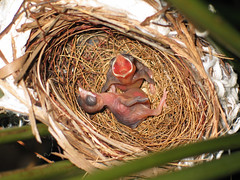
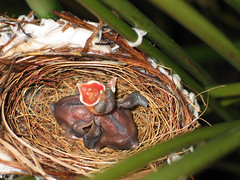
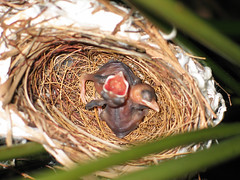
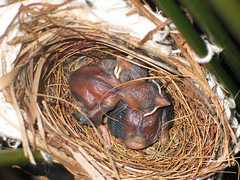
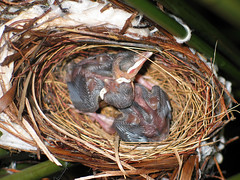
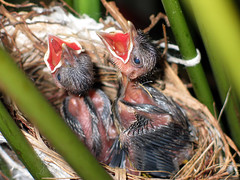
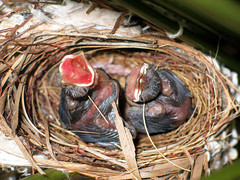
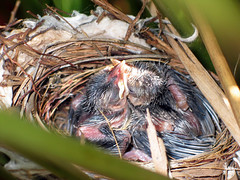
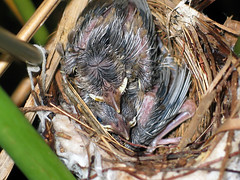
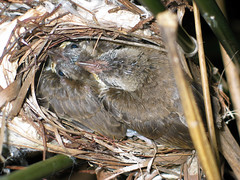
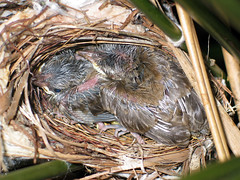
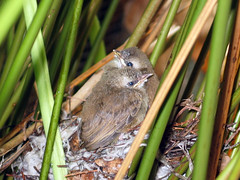
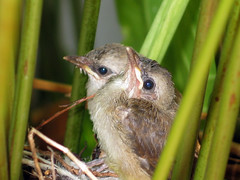
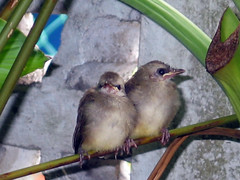
Pycnonotus goiavier) family nesting in our garden some time ago and we feel particularly privileged to have had captured the magic moments in camera. The photos of the 2 bulbul chicks was captured by my husband, helped by the whole family.
FACT SHEET:
Mangrove and wetland wildlife at
Sungei Buloh Nature Park | Main features: Small (20cm); slight crest; white face; yellow under tail coverts.
Adult: Olive brown crown, nape, underparts; white side of head, eyebrow, throat, belly; lores black; breast whitish streaked brown; black bill, feet, eyes. No white on tail.
Genders look alike.
Juvenile: Sides of head brownish; throat greyish.
Call: Described as a pleasing liquid bubbling chatter; loud harsh alarm call chweit-chweit.
Status in Singapore: Very common resident throughout the island and North and South offshore islands.
World distribution: South-east Asia from Myanmar to the Philippines and Java. Not found in Australia.
Classification: Family Pycnonotidae. World 137 species, Singapore 10 species (1 introduced). |
|
|
I cannot believe that so much mass was contained inside the tiny egg. It is as if the chicks sucked in air and increased in volume as soon as they emerged from the shell. Maybe it is exactly so as birds have lungs too.
(On another note: I have witnessed crocodiles and snakes hatching and have been awe-struck with the same phenomenons at the sizes of the hatchlings. Note that babies that emerge from eggs always have a tumour-like attachment at the belly button area. This is the left-over yolk (in
yolk-sac) to tide them over until they are able to get food from their parents or hunt on their own.)
It was so exciting to see the parents caring for their young with utmost care. They were very busy flying back and forth everyday, rain or sun, and doing it so quietly so as not to attract the attention of potential predators.
Mynas and crows are always around and they seem to be threatening the chicks all the time. Of course the cat and shrew are also around.
There was once when we approached the nest and the mother bird turned into a "
drama mamma", flopping around on the ground and making much noise to attract our attention away from her chicks. She was actually pretending to have broken her wing(s) and unable to fly. Once we moved a respectable distance away from the nest, she suddenly flew away!
I have only read of such pretensions but to see it in our own garden is unforgettable.
We were very worried the day the chicks did fly off. It was drizzling that morning and we were straining to see the fledglings. The parents were cajoling their young to fly. (A fledgling is a young bird that has just grown the feathers needed to fly and is capable of surviving outside the nest.)
They flew in short flights into our neighbour's garden. We were not sure if the chicks were strong enough to fly to safer places than the low fence, or small bush in our neighbour's garden. As I said earlier, there were plenty of alert cats on the ground and aggressive crows and mynas in the trees. They have to out-fly all these hazards. If I am not mistaken, the parents were making a lot of noise to attract attention away from the tentative flight of the chicks. Their strategy seem to have worked very well as we were very confused and could not follow the path of the fledglings.
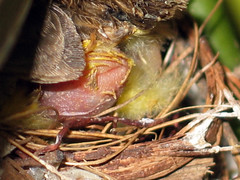
Q: The chicks were well camouflaged when their parents were out hunting/gathering food. When the parents appeared, they opened their huge beaks and the inside of the mouths and throats looked a bright red. Why?
A: The colour and shape of the mouth is supposed to evoke a strong response in the parents to feed their baby.
Also note that their red mouths are prominent in our photos because the chicks being blind at first would react to any slight movement if we were careful not to make it too violent.
Wishing everyone a happy New Year and all the best for 2009. And as wishes are fishes, here's one for you...
<0))))))><Cheers




 Posts
Posts

